

Factorial Experimental Design
Updated:
A Factorial Experimental Design is an experimental strategy in which two or more factors are varied simultaneously, and all possible combinations of their levels are studied. This allows researchers to:
- Estimate the main effect of each factor
- Detect interactions between factors
- Draw conclusions over a wide range of conditions
- Use experimental resources more efficiently than one-factor-at-a-time (OFAT) experiments
Key principle: In a factorial design, every factor combination appears in the experiment — making it possible to separate the independent effect of each factor and assess how factors influence each other.
Why Not One-Factor-at-a-Time (OFAT)?
The traditional approach varies one factor while holding all others constant. This is inefficient and misleading:
| Property | OFAT | Factorial |
|---|---|---|
| Detects interactions | ✗ No | ✓ Yes |
| Efficient use of runs | ✗ No | ✓ Yes |
| Conclusions generalisable | ✗ Limited | ✓ Broad |
| Same information per run | ✗ Less | ✓ More |
Example: If Factor A affects yield differently depending on the level of Factor B, an OFAT experiment will never detect this — but a factorial design will.
Types of Factorial Designs
| Design | Description |
|---|---|
| Full Factorial | All combinations of all factor levels are tested |
| $2^k$ Factorial | $k$ factors each at 2 levels (low/high) |
| $3^k$ Factorial | $k$ factors each at 3 levels |
| $p^k$ General Factorial | $k$ factors each at $p$ levels |
| Fractional Factorial | A carefully chosen fraction of the full factorial |
| Mixed-Level Factorial | Factors at different numbers of levels |
Full Factorial Design
Definition
A full factorial design with $k$ factors, factor $i$ having $l_i$ levels, produces:
\[N = l_1 \times l_2 \times \cdots \times l_k\]total treatment combinations (ignoring replication).
Example: $2 \times 3$ Factorial
Two factors: Temperature (Low, High) and Concentration (10%, 20%, 30%).
\[N = 2 \times 3 = 6 \text{ treatment combinations}\]| Run | Temperature | Concentration |
|---|---|---|
| 1 | Low | 10% |
| 2 | Low | 20% |
| 3 | Low | 30% |
| 4 | High | 10% |
| 5 | High | 20% |
| 6 | High | 30% |
Each combination is replicated $r$ times → Total runs $= 6r$.
The $2^k$ Factorial Design
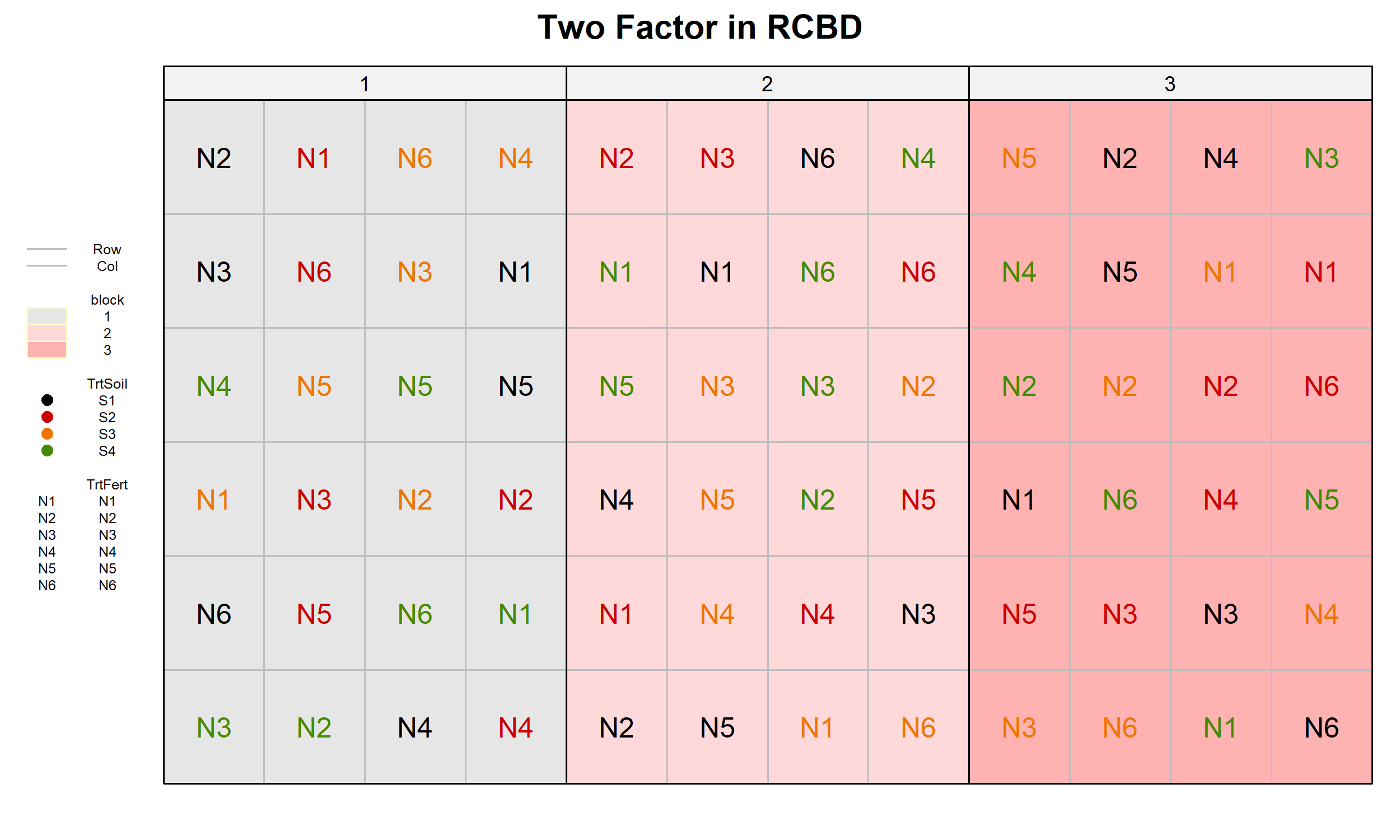
The most widely used factorial structure. Each of $k$ factors is set at exactly two levels, coded as:
\[-1 = \text{low level}, \quad +1 = \text{high level}\]Total runs (before replication): $2^k$
| $k$ (Factors) | Runs ($2^k$) |
|---|---|
| 2 | 4 |
| 3 | 8 |
| 4 | 16 |
| 5 | 32 |
| 6 | 64 |
Design Matrix: $2^2$ Factorial
| Run | A | B | AB |
|---|---|---|---|
| 1 | − | − | + |
| 2 | + | − | − |
| 3 | − | + | − |
| 4 | + | + | + |
Columns A and B are the main effect columns; AB is the interaction column (element-wise product).
Design Matrix: $2^3$ Factorial
| Run | A | B | C | AB | AC | BC | ABC |
|---|---|---|---|---|---|---|---|
| 1 | − | − | − | + | + | + | − |
| 2 | + | − | − | − | − | + | + |
| 3 | − | + | − | − | + | − | + |
| 4 | + | + | − | + | − | − | − |
| 5 | − | − | + | + | − | − | + |
| 6 | + | − | + | − | + | − | − |
| 7 | − | + | + | − | − | + | − |
| 8 | + | + | + | + | + | + | + |
Statistical Model
Two-Factor Factorial Model
\[Y_{ijk} = \mu + \alpha_i + \beta_j + (\alpha\beta)_{ij} + \varepsilon_{ijk}\]| Term | Meaning |
|---|---|
| $\mu$ | Overall mean |
| $\alpha_i$ | Main effect of Factor A, level $i$ |
| $\beta_j$ | Main effect of Factor B, level $j$ |
| $(\alpha\beta)_{ij}$ | Interaction effect of A and B |
| $\varepsilon_{ijk}$ | Random error, $\varepsilon \sim N(0, \sigma^2)$ |
Three-Factor Factorial Model
\[\begin{aligned} Y_{ijkl} =\;& \mu + \alpha_i + \beta_j + \gamma_k \\ &+ (\alpha\beta)_{ij} + (\alpha\gamma)_{ik} \\ &+ (\beta\gamma)_{jk} + (\alpha\beta\gamma)_{ijk} \\ &+ \varepsilon_{ijkl} \end{aligned}\]The number of effects grows rapidly with $k$:
| $k$ | Main Effects | 2FI | 3FI | Total Effects |
|---|---|---|---|---|
| 2 | 2 | 1 | — | 3 |
| 3 | 3 | 3 | 1 | 7 |
| 4 | 4 | 6 | 4 | 15 |
| 5 | 5 | 10 | 10 | 31 |
ANOVA Table
Two-Factor Factorial ($a$ levels of A, $b$ levels of B, $r$ replicates)
| Source | df | SS | MS | F |
|---|---|---|---|---|
| Factor A | $a - 1$ | $SS_A$ | $MS_A$ | $MS_A / MS_E$ |
| Factor B | $b - 1$ | $SS_B$ | $MS_B$ | $MS_B / MS_E$ |
| A × B | $(a-1)(b-1)$ | $SS_{AB}$ | $MS_{AB}$ | $MS_{AB} / MS_E$ |
| Error | $ab(r-1)$ | $SS_E$ | $MS_E$ | — |
| Total | $abr - 1$ | $SS_T$ |
Sums of Squares Formulae
\[\begin{aligned} SS_A &= \frac{br \sum_{i} \bar{Y}_{i..}^2 - N\bar{Y}_{...}^2}{1} \\ SS_B &= \frac{ar \sum_{j} \bar{Y}_{.j.}^2 - N\bar{Y}_{...}^2}{1} \end{aligned}\] \[\begin{aligned} SS_{AB} &= SS_{Cells} - SS_A - SS_B \\ SS_T &= \sum_{i,j,k} Y_{ijk}^2 - N\bar{Y}_{...}^2 \end{aligned}\]Effect Estimation in $2^k$ Designs
Effects are estimated as contrasts of treatment means.
Main Effect of A
\[\hat{A} = \frac{1}{2^{k-1}} \sum_{\text{runs}} c_i Y_i\]where $c_i \in {-1, +1}$ are the contrast coefficients from the design matrix.
Two-Factor Interaction AB
\[\widehat{AB} = \frac{1}{2^{k-1}} \sum_{\text{runs}} (c_A \cdot c_B)_i \, Y_i\]Rule of thumb (Hierarchical Principle): If an interaction is significant, retain all lower-order terms (main effects) in the model, even if they are not individually significant.
Interaction Effects
An interaction between two factors means the effect of one factor depends on the level of the other.
No Interaction
         B = Low   B = High
A = Low    10        20       (Effect of B = +10 at both levels of A)
A = High   15        25
Parallel lines in an interaction plot → no interaction.
Interaction Present
         B = Low   B = High
A = Low    10        20       (Effect of B = +10)
A = High   25        15       (Effect of B = −10)
Crossing or non-parallel lines → interaction present.
When a significant interaction is present, main effects must be interpreted conditionally — report simple effects of each factor at each level of the other factor.
Worked Example
Experiment: Effect of Fertiliser type (A: Organic, Inorganic) and Irrigation level (B: Low, Medium, High) on crop yield (t/ha), with $r = 3$ replicates.
Parameters
\[a = 2,\quad b = 3,\quad r = 3\] \[N = 2 \times 3 \times 3 = 18\]Mean Yields (t/ha)
| B: Low | B: Medium | B: High | Row Mean | |
|---|---|---|---|---|
| A: Organic | 3.2 | 4.5 | 5.1 | 4.27 |
| A: Inorganic | 4.0 | 5.8 | 6.3 | 5.37 |
| Column Mean | 3.6 | 5.15 | 5.7 | 4.82 |
Degrees of Freedom
| Source | df |
|---|---|
| Factor A (Fertiliser) | $2 - 1 = 1$ |
| Factor B (Irrigation) | $3 - 1 = 2$ |
| A × B | $1 \times 2 = 2$ |
| Error | $6 \times 2 = 12$ |
| Total | $17$ |
Analysis in R
Full Factorial ANOVA
# Load data
data <- read.csv("factorial_data.csv")
data$fertiliser <- factor(data$fertiliser)
data$irrigation <- factor(data$irrigation)

# Fit model
model <- aov(yield ~ fertiliser * irrigation, data = data)

# ANOVA table
summary(model)

# Check model assumptions
par(mfrow = c(2, 2))
plot(model)

# Interaction plot
interaction.plot(data$irrigation, data$fertiliser, data$yield,
                 col = c("steelblue", "tomato"),
                 xlab = "Irrigation Level",
                 ylab = "Mean Yield (t/ha)",
                 trace.label = "Fertiliser")
Post-hoc Comparisons
library(emmeans)

# Marginal means
emmeans(model, ~ fertiliser)
emmeans(model, ~ irrigation)

# Simple effects (conditional on interaction being significant)
emmeans(model, pairwise ~ irrigation | fertiliser, adjust = "tukey")
$2^k$ Design Analysis
library(FrF2)

# Generate a 2^3 factorial design
design <- FrF2(nruns = 8, nfactors = 3,
               factor.names = list(A = c(-1, 1),
                                   B = c(-1, 1),
                                   C = c(-1, 1)))

# After adding response column:
model_2k <- lm(yield ~ A * B * C, data = design_with_response)
summary(model_2k)

# Half-normal plot of effects
library(unrepx)
hnplot(coef(model_2k)[-1], method = "Lenth")
Analysis in SAS
/* Two-factor factorial ANOVA */
proc glm data=factorial_data;
  class fertiliser irrigation;
  model yield = fertiliser | irrigation;
  means fertiliser irrigation / tukey;
  lsmeans fertiliser*irrigation / pdiff slice=fertiliser adjust=tukey;
run;

/* Interaction plot */
proc sgplot data=factorial_data;
  series x=irrigation y=yield / group=fertiliser markers;
  xaxis label="Irrigation Level";
  yaxis label="Mean Yield (t/ha)";
run;
Fractional Factorial Design
When $k$ is large, a full $2^k$ design requires too many runs. A $2^{k-p}$ fractional factorial uses only $1/2^p$ of the full design, sacrificing the ability to estimate some high-order interactions.
Resolution
| Resolution | Property |
|---|---|
| III | Main effects aliased with 2FIs; 2FIs aliased with each other |
| IV | Main effects clear of 2FIs; 2FIs aliased with each other |
| V | Main effects and 2FIs clear; 3FIs aliased with 2FIs |
Principle of effect sparsity (Pareto principle): In most real systems, a small number of main effects and low-order interactions dominate. Higher-order effects are usually negligible — making fractional designs practically valid.
Common Fractional Designs
| Design | Runs | Factors | Resolution |
|---|---|---|---|
| $2^{3-1}$ | 4 | 3 | III |
| $2^{4-1}$ | 8 | 4 | IV |
| $2^{5-2}$ | 8 | 5 | III |
| $2^{6-2}$ | 16 | 6 | IV |
| $2^{7-4}$ | 8 | 7 | III |
Assumptions
- Normality — Residuals are approximately normally distributed. Check with Q–Q plot.
- Homogeneity of variance — Equal variances across all cells. Check with Levene’s test or residual vs. fitted plot.
- Independence — Observations are independent. Ensured by proper randomisation.
- Additivity — The model correctly specifies all relevant interaction terms.
- Fixed effects — Unless factors are treated as random, all factor levels are fixed and chosen deliberately.
Advantages and Disadvantages
Advantages ✓
- Estimates all main effects and interactions simultaneously
- More statistically efficient than OFAT — same information from fewer runs
- Detects synergistic or antagonistic interactions between factors
- Conclusions hold across the full experimental region
- Forms the basis for response surface methodology (RSM)
Disadvantages ✗
- Number of runs grows exponentially with factors: $2^{10} = 1024$ runs for 10 factors
- High-order interactions (3FI and above) are difficult to interpret
- Requires adequate replication to estimate error
- May be impractical when factor-level changes are costly (consider split plot instead)
Relationship to Other Designs
| Design | Relation to Factorial |
|---|---|
| RCBD | Single-factor; factorial adds more factors within blocks |
| Split Plot | Factorial with restricted randomisation |
| Response Surface (CCD, BBD) | Factorial augmented with centre and axial points |
| Taguchi Arrays | Fractional factorials with emphasis on noise factors |
| Latin Square | Two blocking factors; factorial adds treatment combinations |
Glossary
| Term | Definition |
|---|---|
| Main effect | Average change in response when a factor moves from low to high level |
| Interaction | Change in the effect of one factor depending on the level of another |
| Treatment combination | Specific set of levels of all factors in one run |
| Replication | Independent repetition of a treatment combination |
| Alias | Two effects that cannot be estimated separately (fractional designs) |
| Resolution | Measure of which effects are aliased in a fractional design |
| Contrast | Linear combination of treatment means used to estimate an effect |
| Effect sparsity | Assumption that few effects are large; most are negligible |
References
- Montgomery, D.C. (2017). Design and Analysis of Experiments (9th ed.). Wiley.
- Box, G.E.P., Hunter, J.S., & Hunter, W.G. (2005). Statistics for Experimenters (2nd ed.). Wiley.
- Wu, C.F.J. & Hamada, M.S. (2021). Experiments: Planning, Analysis, and Optimization (3rd ed.). Wiley.
- Dean, A., Voss, D., & Draguljić, D. (2017). Design and Analysis of Experiments (2nd ed.). Springer.
- Myers, R.H., Montgomery, D.C., & Anderson-Cook, C.M. (2016). Response Surface Methodology (4th ed.). Wiley.
Leave a comment